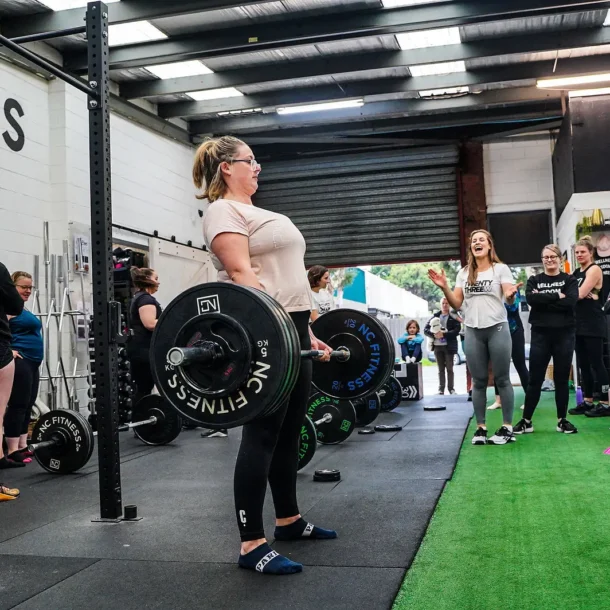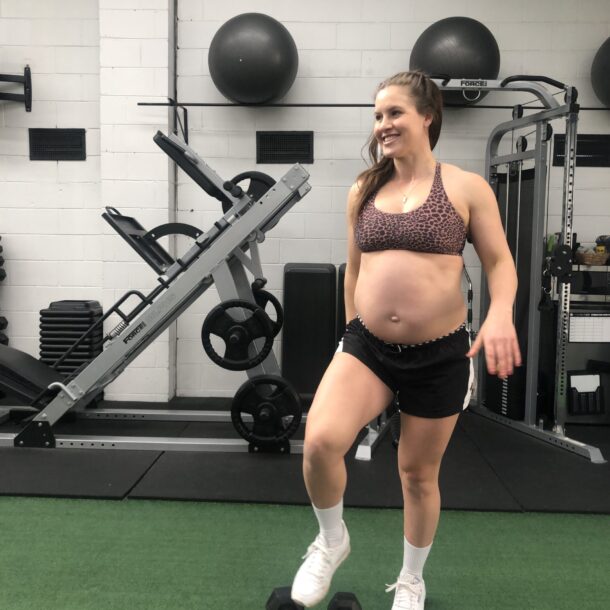
This comes up all the time in the gym.
Someone can deadlift 80kg, squat a decent amount of weight… and then we give them a single-leg squat, split squat or single-leg RDL and suddenly everything feels HARD.
The foot is wobbling. The knee wants to dive in. The pelvis starts moving everywhere. And the weight they can lift suddenly drops dramatically.
It doesn’t necessarily mean they’re weak.
It tells us that producing force and controlling force are two different skills.
And when we’re talking about building strong, healthy hips, I want both.
We often talk about the glutes as one big muscle group, but there are three: gluteus maximus, gluteus medius and gluteus minimus.
Glute max is our big force producer. It’s incredibly important for powerful hip extension, think standing up from a squat, deadlifting, sprinting and jumping.
But glute med and minimus have another incredibly important job.
They help stabilise the hip and pelvis.
When you’re standing on one leg, running, lunging or squatting, these muscles help control the position of the pelvis and femur. They contribute to stopping the pelvis excessively dropping or rotating and help control the thigh underneath us.
I like thinking about it this way:
Your big muscles create movement. Your stabilisers help give them a solid platform to create that movement from.
That’s why someone can be objectively strong and still struggle enormously with single-leg exercises.
This is probably one of the most common questions I get as a coach:
“But I couldn’t feel it in my glute?”
That doesn’t automatically mean the exercise wasn’t working.
Put a mini band around your knees and do 40 tiny abductions and I can almost guarantee you’ll get a burning sensation in your glutes.
But a burn isn’t the same thing as building useful strength.
I’m much more interested in whether you can:
That’s the stuff that transfers.
So if I were ranking some of my favourite hip exercises based on effectiveness, efficiency and how well they integrate into actual movement, this is roughly where I’d put them.
This might be one of my absolute favourites.
Stand on a box or step, lower yourself under control and lightly touch the opposite heel towards the floor.
Simple? Not really.
Your stance leg has to control what’s happening at the foot, knee, femur and pelvis while simultaneously producing enough force to lower and raise your body.
Watch what happens. Does your pelvis drop? Does your knee collapse inwards? Does your foot lose its position? Do you suddenly rotate to find stability?
This exercise gives us an enormous amount of information while also training the exact qualities we’re looking at.
Squat University also highlights single-leg squat variations as an excellent way of integrating hip strength into functional movement.
Start low. Earn the height. Then add load.
Another absolute winner.
The single-leg RDL asks your stance hip to stabilise while you’re simultaneously producing force through the posterior chain.
Your foot needs to stay connected to the ground. Your pelvis needs to control rotation. Your glutes and hamstrings need to produce force.
Your trunk needs to stay organised.
And your hip needs to essentially steer the entire movement.
It’s also very easy to progress.
Start assisted if balance is the limiting factor. Then bodyweight. Then add load. Then play with contralateral or ipsilateral loading to change the stability demand.
This is a great example of why I don’t care whether your glute is “burning.”
The split squat gets a very high ranking because it gives us something some of the more challenging single-leg exercises don’t:
Stability AND the ability to load heavily.
You’ve got both feet on the ground, so balance doesn’t become the sole limiting factor.
But your front hip still has a huge job controlling the femur and pelvis while producing force.
This means we can actually build serious strength. Dumbbells. Front rack. Barbell. Offset loading. There are countless ways to progress it.
And if someone’s knee has a tendency to collapse inward, we can even use reactive neuromuscular training — adding a light band pulling the knee inward and asking the athlete to actively maintain alignment — as a teaching tool.
This is where things get really interesting.
Because your hips don’t only need to stop movement.
They need to control movement.
The hip airplane starts from a single-leg RDL-type position and introduces rotation of the pelvis around the stance hip.
Now your hip has to control internal and external rotation while your foot remains connected to the ground and your knee maintains position.
This is much closer to what happens in real movement.
Walking, running, changing direction and lifting aren’t perfectly straight-line activities.
The hip airplane teaches you to own rotation rather than simply avoiding it.
Squat University describes it as a way to develop the ability to actively control the glutes through rotation and improve coordination around the hip.
I love this one in warm-ups.
The reverse lunge is probably one of my favourite all-round strength exercises on this entire list.
It gives us single-leg loading without demanding quite as much balance as a true single-leg squat.
You get hip and knee strength.
Pelvic stability. Trunk control. Deceleration. And a fantastic opportunity for progressive overload.
Once someone owns the basic movement, I’ll often introduce offset loading, holding more load on one side, because now the trunk and pelvis have another force to resist.
That makes an already useful exercise even more integrated.
Now we’re moving towards exercises that isolate the lateral hip a little more.
A side plank with a leg lift gives us a lovely combination of lateral trunk stability and hip abduction.
That matters because your pelvis doesn’t exist independently of your trunk.
The muscles above and below it need to work together.
I particularly like this as an accessory exercise because you’re getting hip + trunk for your training dollar.
I still really like lateral band walks.
They’re simple. They’re accessible. They’re easy to put into a warm-up. And they can be excellent for targeting the lateral glutes.
The important thing is how you perform them.
Rather than simply reaching the leading leg further and further sideways, think about the stance/trailing leg pushing you across while maintaining a stable pelvis, knee and foot.
Standing exercises like lateral band walks can be useful for targeting the lateral glutes, and Squat University has used them extensively as a bridge towards higher-level weight-bearing movement.
Will they burn? Probably. But that’s not why they’re here. They’re preparation for the bigger work.
I love hip thrusts.
They’re one of the best ways we have to progressively load hip extension and build a strong glute max. But I wouldn’t put them at the top of my hip stability list.
Why? Because the bench and two feet provide a lot of external stability. That’s not bad, it actually allows us to load the glutes very heavily. But we’re training a slightly different quality.
Hip thrusts are brilliant for producing force. Single-leg exercises teach us to control force. A well-designed program probably needs both.
This is probably the biggest takeaway.
If someone is returning from pain or struggling significantly with control, I might start with simpler exercises. Then we progressively add load, speed and complexity. The goal isn’t to find the one magical glute exercise.
The goal is to build capacity. And eventually your hip needs to be able to stabilise you while the rest of your body is doing something difficult.
That’s why you’ll see so much unilateral work in our 23W programming. They’re often humbling. But that’s the point. So next time you finish a set and think:
“I didn’t really feel that in my glute…” Ask yourself a better question.
Did I control it? Then:
Can I progressively load it? Because we’re not training your glutes simply to make them burn.
We’re training them to do their job.

Ange Drake is a personal trainer, women’s empowerment coach and fitness blogger in the northern suburbs of Melbourne. She is the director of one of the few womens’ only strength training gyms in Melbourne, 23W. Ange helps women to learn how to use strength based training, nutritional strategies and a positive mindset to transform their bodies, relationship with food and mind.